Gonna make some wood planks

Bobby Cole

Well-known member
This could have gone into the “repurposing” or even the “clutter/uncluttering thread for most certainly when a tree becomes several boards or a neighbor’s felled trees are pretty much removed by way of making planks out of them it sorta depends on how a person looks at things so….I said the heck with it and started a new thread.

There are still 4-5 trees left to fell so I probably won’t be starting work until they come down but I have the milling rail / guide ordered and a couple of 24” ripping chains to go onto a newly ordered 24” bar for my Poulan chain saw. I already have an 18” bar with a couple of new chains left over from my last venture playing lumberjack.

In my dream world, I am imagining 15” to 23” trees being turned into 1” boards of various widths. I’ve worked with green wood before and know about the shrinkage and warpage so to start anyway, I’m going to plane them down for smoothness and uniformity and a lot of them will probably wind up being the inside walls of the workout room I’m building behind my woodshop.
The shrinkage I mentioned is expected but since I’m building a workout room and not a Baldwin piano, I don’t care. I never use nails anymore so any tightening up I need to do later will just be a case of removing and resetting some screws.

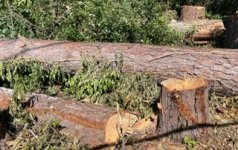
Well, here’s the “repurposing” and “uncluttering” job I’ve given myself. If I don’t procrastinate or die before I get started, I’ll keep ya’ll updatedIMG_0205.jpegIMG_0204.jpegIMG_0203.jpeg
 
Last edited:
This could have gone into the “repurposing” or even the “clutter/uncluttering thread for most certainly when a tree becomes several boards or a neighbor’s felled trees are pretty much removed by way of making planks out of them it sorta depends on how a person looks at things so….I said the heck with it and started a new thread.

There are still 4-5 trees left to fell so I probably won’t be starting work until they come down but I have the milling rail / guide ordered and a couple of 24” ripping chains to go onto a newly ordered 24” bar for my Poulan chain saw. I already have an 18” bar with a couple of new chains left over from my last venture playing lumberjack.

In my dream world, I am imagining 15” to 23” trees being turned into 1” boards of various widths. I’ve worked with green wood before and know about the shrinkage and warpage so to start anyway, I’m going to plane them down for smoothness and uniformity and a lot of them will probably wind up being the inside walls of the workout room I’m building behind my woodshop.
The shrinkage I mentioned is expected but since I’m building a workout room and not a Baldwin piano, I don’t care. I never use nails anymore so any tightening up I need to do later will just be a case of removing and resetting some screws.

Well, here’s the “repurposing” and “uncluttering” job I’ve given myself. If I don’t procrastinate or die before I get started, I’ll keep ya’ll updatedView attachment 2205View attachment 2206View attachment 2207
I have a small chain saw mill that I have never used. I bought it several years ago, but I have so many other things to do that I just have never gotten around to it. I intended to use the mill on some cottonwood trunks I have cut down just to use the wood for something. I have a LOT of spruce on the property that we use for decorative fire on the patio and the greenhouse. Birch is our best firewood, so I try to save that for the house and the shop.
 
I have a small chain saw mill that I have never used. I bought it several years ago, but I have so many other things to do that I just have never gotten around to it. I intended to use the mill on some cottonwood trunks I have cut down just to use the wood for something. I have a LOT of spruce on the property that we use for decorative fire on the patio and the greenhouse. Birch is our best firewood, so I try to save that for the house and the shop.
About 23 or so years ago, Yvonne had a few birch trees on her property in Idaho that had gotten sick and fallen so I did some research about birch bark and the viability of selling it.
I should have pursued it a bit further but we had so many irons in the fire that I just didn’t get around to getting out there and stripping the bark off the logs but come to find out, the bark sells by the pound for a pretty decent price for those using it for medicinal purposes and hobbyists.
 
About 23 or so years ago, Yvonne had a few birch trees on her property in Idaho that had gotten sick and fallen so I did some research about birch bark and the viability of selling it.
I should have pursued it a bit further but we had so many irons in the fire that I just didn’t get around to getting out there and stripping the bark off the logs but come to find out, the bark sells by the pound for a pretty decent price for those using it for medicinal purposes and hobbyists.
We have too many birch trees here to sell the bark I think. I haven't checked, but I have not heard of any one selling it here. Birch sap/syrup sells and chaga sells if you find the right market, but I haven't seen any other birch products for sale other than slabs. I will keep my eyes open for others selling the stuff though. Thanks @Bobby Cole
 
We have too many birch trees here to sell the bark I think. I haven't checked, but I have not heard of any one selling it here. Birch sap/syrup sells and chaga sells if you find the right market, but I haven't seen any other birch products for sale other than slabs. I will keep my eyes open for others selling the stuff though. Thanks @Bobby Cole
There’s a pretty big call for ground and sifted birch bark for tea and for the slabs for those who make it.
Along with other benefits, it’s a pain killer, an anti-inflammatory, and also a diuretic.

From my understanding, several of the tribes in Alaska use birch for a myriad of purposes including making medicine but they pretty much do their own thing not depending on outside sources.

Anyway, the loggers showed up again today but only felled 3 more trees. No worries. My orders won’t start showing up until the 17th.
 
I wonder if it could sell on Ebay. Clean, sifted, weighted and hand packed fresh...
I have bought roots ie burdock that way on amazon. Only adulterated once.
Uhmmmmm NEVER buy teasel root from China. I am not sure they know what it is.
 
Okee-Dokee !
Part of my orders did come on the 17th and some not until a little later but I finally got the mill together and married it up with a 62cc chainsaw w/ a 24” bar and a new ripping chain.
The widest board I will be able to glean is about 20” so I’ll have to do a lot of freehand ripping in order to trim some of the trees down to mill specs.

Even though I’ve felled quite a few trees, I have never tried hard to save anything for anything else other than firewood for whomever wanted it so using this new mill and being able to use the lumber productively is a new experience.

It is pretty much a given that I am going to make some grandiose mistakes but as long as I don’t amputate a part of my body and I learn from my mistakes, I figure that the experience will do me good even at my tender age.
 

Attachments

  • IMG_0162.jpeg
    IMG_0162.jpeg
    22.5 KB · Views: 4
Nothing to it as long as you have a straight rail for making the first slab cut. Then cut each side at a perfect 90 degrees from the top cut, then just cutting boards off the cant. A peevy will come in handy. Stack it with stickers and let it dry. You will be glad you did. It will finish up nicer for inside use if dry.

I cut several thousand board feet of all thickness including half inch for wall paneling. Keep your chain teeth sharp and cut down the rakers for faster cutting, but it makes a rougher cut. You size your raker height by watching if the sawdust is too fine or if pulling too big and long slivers. Bigger trees are nice for making beams.

I loved cutting lumber with my old Alaskan chainsaw mill.
 
Last edited:
I was amazed with all the videos on You Tube about chainsaw mills.

One thing I just remembered, watching some young guy pushing hard, was besides having the right chain and keeping it sharp, was getting the logs up higher on the starting end so it will feed itself. When I fell large trees downhill, it sometimes required holding it back depending on how steep it was. The ideal was about a 15 degrees.
 
Last edited:
I was amazed with all the videos on You Tube about chainsaw mills.

One thing I just remembered, watching some young guy pushing hard, was besides having the right chain and keeping it sharp, was getting the logs up higher on the starting end so it will feed itself. When I fell large trees downhill, it sometimes required holding it back depending on how steep it was. The ideal was about a 15 degrees.
Yep. I looked at a few of them and some were good and some not so good but in truth, I gleaned a little bit from even the worst of them.
That said, with the exception of a guy who hauled up a 8’ section with his front -end loader, I didn’t see anyone use a cant hook/ lifter like I saw a couple of firewood guys IMG_0167.jpeghad a few years ago.

So, to make it sweet, I bought one for turning the logs and propping one side up. I didn’t really think of the gravitational aspect of a lifter more than getting a better and more visible start to my cuts.
And to your well founded point @Faye Fox, if propping that puppy up makes life easier on me and the chainsaw, I’m all for it! I like lifting and stuff but I’ve gone 76 years without getting a hernia (shouldn’t that be a “himnia”?) so I’m not looking for one now.

So far I’m good with the chains: One saw with a crosscut and the bigger one with a ripping chain. And to boot, I HATE dull blades of any kind. My chisels, saw blades, router bits, drill bits, chain saw chains etc all stay sharp and I don’t mind the extra time it takes to keep them that way albeit I did buy a couple extra ripping chains and a crosscut chain mainly because I do not like to stop very long when I’m in the middle of a project.
 
Last edited:
I have a small chain saw mill but have yet to use it. I just have too much to do. I had some poplar logs set aside to use as siding on an outbuilding. I just haven't done it yet. Some guys I talked to said the ripping chain didn't add much if you had a good, sharp cross cut chain. It cut almost as fast and you didn't have to keep switching chains if you were both cutting and milling at the same time.
 
I have a small chain saw mill but have yet to use it. I just have too much to do. I had some poplar logs set aside to use as siding on an outbuilding. I just haven't done it yet. Some guys I talked to said the ripping chain didn't add much if you had a good, sharp cross cut chain. It cut almost as fast and you didn't have to keep switching chains if you were both cutting and milling at the same time.
Yeah, I know all about that time thing. I should have gotten started last week but whilst I’d like to do the lumbering in the morning when it’s cool, something invariably comes up and then the afternoons are too hot for anything but floating around in the pool.

The only real difference I have found between the rip and crosscut chains are that the rip has a smoother cut. I have a few projects in mind for the lumber and for some, the smoother the cut is the better. Can’t have that planer working too hard. It’s old too ….just like me.
I do have 2 gas chainsaws; one with a 20” bar with a crosscut chain and the other has a 24” bar with the ripping chain.
BUT WAIT..THERE’S MORE ! I have a 16” and a 18” bar w/ crosscuts and backup chains for the whole schmear.

And….if everything goes as planned, (I think God has a good laugh when I say I have plans) I’ll be milling on Wimpy’s day. Ya know, the day when Wimpy pays for his hamburgers…Tuesday. hahahahahahahahha
 
I always had 2 saws. The Husky 2100, a 10 hp, was for the mill. I used the Husky 266 for falling and bumping knots. I used chisel point chains on both, but 2100 was filed at a steeper angle and rakers were cut lower. I always touched up my chains every gas time. Also roller tip bars since high rpm saws, so had to lube the tips every refueling.

I tried the skip tooth ripping chain and took it off and gave it away. I see there is a different design mill now where the rail is just a board and you cut vertical instead of horizontal. I think it would be nice for small projects, but too slow for any production job. It also lacks the ability to self feed and just use minimal guidance. I suppose if the log was about 30 degrees elevated starting end, it might feed nicely. I cut a few 4 X 6 Manzanita (very hard wood) short boards freehand with my electric Stihl. It is a real beast with its 1/4" chain.

Online photo of vertical mill.
CM001-2767943203.jpg
 
Last edited:
I always had 2 saws. The Husky 2100, a 10 hp, was for the mill. I used the Husky 266 for falling and bumping knots. I used chisel point chains on both, but 2100 was filed at a steeper angle and rakers were cut lower. I always touched up my chains every gas time. Also roller tip bars since high rpm saws, so had to lube the tips every refueling.

I tried the skip tooth ripping chain and took it off and gave it away. I see there is a different design mill now where the rail is just a board and you cut vertical instead of horizontal. I think it would be nice for small projects, but too slow for any production job. It also lacks the ability to self feed and just use minimal guidance. I suppose if the log was about 30 degrees elevated starting end, it might feed nicely. I cut a few 4 X 6 Manzanita (very hard wood) short boards freehand with my electric Stihl. It is a real beast with its 1/4" chain.

Online photo of vertical mill.
View attachment 2628
 
I ran into a video on YouTube where a guy was giving a review of that milling bracket and yes, it was indeed fascinating. He needed an 8 by 8 or maybe it was 10 by 10 but anyway, using a small gadget compared to a whole milling rig got me interested enough to look it up on Amazon. The least expensive one was about 60 beans but since I still had questions, I decided to wait.

I suppose the main question I have is about stability. With a Granburg (or something similar), the whole bar is held in place at the base and about 3” from the nose of the bar whereas with the small mill, only the base of the bar is stabilized which to me, would give heavier grained wood the ability to push or pull the rest of the bar sideways leaving less than a straight perpendicular cut.
But, back to the review guy, his cuts were exactly 90 degrees at each end although being the less than trusting gentleman that I am, I do not know how many times he did it in order to get it right and gain a sponsorship.

Of course, that thinking didn’t come from using the gadget but my experiences with a Sabre saw with and without the centered blade guide bearing. With the guide, everything runs relatively cool but without it the blade can travel no matter how steady and certain the base plate is relative to the wood.

All that said, if it feels like I’m taking too much time making 2x4’s, 4x4’s and one inch planks, I might give the thing a try.
 
I ran into a video on YouTube where a guy was giving a review of that milling bracket and yes, it was indeed fascinating. He needed an 8 by 8 or maybe it was 10 by 10 but anyway, using a small gadget compared to a whole milling rig got me interested enough to look it up on Amazon. The least expensive one was about 60 beans but since I still had questions, I decided to wait.

I suppose the main question I have is about stability. With a Granburg (or something similar), the whole bar is held in place at the base and about 3” from the nose of the bar whereas with the small mill, only the base of the bar is stabilized which to me, would give heavier grained wood the ability to push or pull the rest of the bar sideways leaving less than a straight perpendicular cut.
But, back to the review guy, his cuts were exactly 90 degrees at each end although being the less than trusting gentleman that I am, I do not know how many times he did it in order to get it right and gain a sponsorship.

Of course, that thinking didn’t come from using the gadget but my experiences with a Sabre saw with and without the centered blade guide bearing. With the guide, everything runs relatively cool but without it the blade can travel no matter how steady and certain the base plate is relative to the wood.

All that said, if it feels like I’m taking too much time making 2x4’s, 4x4’s and one inch planks, I might give the thing a try.
Just get a Woodmizer and forget the chainsaw;)
 
@Bobby Cole All the videos I have seen of this mill, were used with short bars. I have a feeling a longer bar would have to much run out and more chatter. I like the simplicity of the setup, but I can see it would take more control and be slower.

For doing a few small logs, it might be the thing. I think back in the day when I was ripping 3" bats from 1 X 12's, having this setup on a smaller saw would have been ideal. What I did was clamp 12 sawn 1 X 12's, together on edge and then set mill for 3" depth and each cut gave 12 bats.

I see this setup useful for unedged slabs. Use the Grandburg to cut slabs and then use this mill to edge them. That would save peevy work and slabs could be put up on sawhorses for edging. This would also have less waste in the barked slabs where if a clean cant with square edges is made, a lot of good material is left in the center. I used the barked slab to side a barn, but more dimensional and debarked lumber would have looked better.
 
I looked at a lot of different mills after buying our camp land, knowing that I would be cutting a lot of trees, but I couldn't decide on anything. Some of them, I couldn't afford, and I couldn't determine whether or not I'd be likely to lose a limb from the others.
 
Back
Top