No, this isn't about school shooters. Beginning about ten years ago, after I cleared the slope from the railroad bed to my backyard, I placed a bunch of old branches and some small logs to create a primitive form of terracing, or at least to reduce erosion, and then spread a bunch of mixed flower seeds, with a focus on perennials. Not seeing much in the way of results, I spread more perennial flower seeds every now and then. Other than a few of the larger species of lupines and a few other flower plants that may have been weeds, and not anything that came with the seed packets, I didn't see much from it. A few years ago, I distributed pretty much every type of lupine seed I could find, given that the lupines grow wild throughout Maine, but only the giant varieties of lupines flowered, and only a few of them. Other lupines come up each spring, but without flowering.
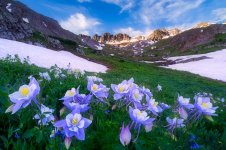
In another spot, nearby but not on the slope up to the railroad bed, I planted columbines last spring. They grew but remained very tiny and didn't flower, which I had anticipated because they don't usually flower in their first year. Well, this year these columbines have grown much larger than they did last year, but still haven't flowered. However, I am seeing flowering columbines all along the slope going up to the railroad bed, obviously from the mixed wildflower packets that I had distributed over the past ten years. I didn't even notice the plants last year, but, when small, the columbine plants look a bit like clover unless you look closely, so I probably just overlooked them. Since little else was growing on that incline, I wasn't concerned about clover.
So, the columbines are blooming all along that incline and in a couple of other smaller flower gardens in my backyard.
In another spot, nearby but not on the slope up to the railroad bed, I planted columbines last spring. They grew but remained very tiny and didn't flower, which I had anticipated because they don't usually flower in their first year. Well, this year these columbines have grown much larger than they did last year, but still haven't flowered. However, I am seeing flowering columbines all along the slope going up to the railroad bed, obviously from the mixed wildflower packets that I had distributed over the past ten years. I didn't even notice the plants last year, but, when small, the columbine plants look a bit like clover unless you look closely, so I probably just overlooked them. Since little else was growing on that incline, I wasn't concerned about clover.
So, the columbines are blooming all along that incline and in a couple of other smaller flower gardens in my backyard.