Bread making thread

Yvonne Smith

Greeter
Staff member
I just watched a really informative video that talks about how they made bread back in the medieval days, and why it was so much healthier than the bread that we have now. One of the main things is that they let the dough ferment and rise for at least a full 24 hours before making it into bread, that gives the yeast and bacteria time to fully do their fermenting job, which is what turns the grains into something that our body can digest.

They also used a mixture of grains, and grew several different kinds, so in case one crop failed, they might still have grain from a different crop, usually one of the ancient wheat varieties and also rye, which is more active during fermentation, and gives a better loaf of bread.
They added the fresh brewers yeast from brewing ale to help the bread rise better, so those old time breads really had a lot more nutrients than our bread nowadays has, especially with the longer rise time.

 
Homemade bread is still better and nutritious than what you can buy in the store, I think. The only thing negative about homemade bread is that it will dry out quickly if it is not frozen, or ate fairly quick. I still prefer it over store bread though.

I don't know what is going on with store bread! It is gummy and has a laundry list of ingredients. Store bread never used be like that.
 
Homemade bread is still better and nutritious than what you can buy in the store, I think. The only thing negative about homemade bread is that it will dry out quickly if it is not frozen, or ate fairly quick. I still prefer it over store bread though.

I don't know what is going on with store bread! It is gummy and has a laundry list of ingredients. Store bread never used be like that.
I notice that store bread lasts for weeks without molding now. Gotta wonder what kind of chemicals they are adding for that. My homemade bread will get mold in 4-5 days unless I refrigerate/freeze it.
 
I gotta think the 24 hour rise time of breads in the past was because the flour was not as refined as it is today, and/or the yeast was not as strong (since they likely used the dregs from fermented beverages. The gluten was probably less available/broken down. It's been a while since I've made bread. When I made buns, it was usually a ciabatta recipe, since that's thee only recipe that has any depth of flavor.

I posted this pic on the old forum. A handful of us at a church I was going to hosted a Christmas Dinner for 50 people. One of the things I made was French Bread:

French Bread.jpg

It was fun...but only once.
 
This is the recipe for my favorite hamburger buns. These are more dense than store-bought and very flavorful.

Hamburger Buns
  • 3 1/2 cups (420g) all purpose flour
  • 3/4 cup plus 2 tablespoons (198g) water, lukewarm
  • 2 tablespoons (28g) butter, at room temperature
  • 1 large egg
  • 1/4 cup (50g) granulated sugar
  • 1 1/4 teaspoons table salt
  • 1 tablespoon (9g) instant yeast
Butter glaze
  • 3 tablespoons (43g) butter, melted; divided

Seed topping (optional)
  • 1 large egg white, whisked with 2 tablespoons cold water*
  • sesame seeds, or the seeds of your choice
  • *For added richness and color, add the yolk left over from separating the egg to the dough above.
Instructions
  1. Weigh your flour; or measure it by gently spooning it into a cup, then sweeping off any excess.
  2. To make the dough: Mix and knead all of the dough ingredients — by hand, mixer, or bread machine — to make a soft, smooth dough.
  3. Cover the dough and let it rise until it's nearly doubled in bulk, about 1 to 2 hours.
  4. To shape the buns: Gently deflate the dough and divide it into eight pieces (about 100g each). Shape each piece into a ball.
  5. Flatten each dough ball with the palm of your hand until it's about 3" in diameter.
  6. Place the buns on a lightly greased or parchment-lined baking sheet. Cover and let rise until noticeably puffy, about an hour. Toward the end of the rising time, preheat the oven to 375°F.
  7. To add the butter glaze: Brush the buns with about half of the melted butter. To make seeded buns, brush the egg white/water mixture right over the melted butter; it'll make the seeds adhere. Sprinkle buns with the seeds of your choice.
  8. To bake the buns: Bake the buns for 15 to 18 minutes, until golden. Remove them from the oven and brush with the remaining melted butter; this will give the buns a satiny, buttery crust. If you've made seeded buns, apply the melted butter carefully, to avoid brushing the seeds off the buns.
  9. Cool the buns on a rack before slicing in half, horizontally. Use as a base for burgers (beef or plant-based) or any favorite sandwich filling.
  10. Storage information: Store leftover buns, well-wrapped, at room temperature for several days; freeze for longer storage.
 
Last edited:
This is the recipe for my favorite hamburger buns. These are more dense than store-bought and very flavorful.

Hamburger Buns
  • 3 1/2 cups (420g)
  • 3/4 cup plus 2 tablespoons (198g) water, lukewarm
  • 2 tablespoons (28g) butter, at room temperature
  • 1 large egg
  • 1/4 cup (50g) granulated sugar
  • 1 1/4 teaspoons table salt
  • 1 tablespoon (9g) instant yeast
Butter glaze
  • 3 tablespoons (43g) butter, melted; divided

Seed topping (optional)
  • 1 large egg white, whisked with 2 tablespoons cold water*
  • sesame seeds, or the seeds of your choice
  • *For added richness and color, add the yolk left over from separating the egg to the dough above.
Instructions
  1. Weigh your flour; or measure it by gently spooning it into a cup, then sweeping off any excess.
  2. To make the dough: Mix and knead all of the dough ingredients — by hand, mixer, or bread machine — to make a soft, smooth dough.
  3. Cover the dough and let it rise until it's nearly doubled in bulk, about 1 to 2 hours.
  4. To shape the buns: Gently deflate the dough and divide it into eight pieces (about 100g each). Shape each piece into a ball.
  5. Flatten each dough ball with the palm of your hand until it's about 3" in diameter.
  6. Place the buns on a lightly greased or parchment-lined baking sheet. Cover and let rise until noticeably puffy, about an hour. Toward the end of the rising time, preheat the oven to 375°F.
  7. To add the butter glaze: Brush the buns with about half of the melted butter. To make seeded buns, brush the egg white/water mixture right over the melted butter; it'll make the seeds adhere. Sprinkle buns with the seeds of your choice.
  8. To bake the buns: Bake the buns for 15 to 18 minutes, until golden. Remove them from the oven and brush with the remaining melted butter; this will give the buns a satiny, buttery crust. If you've made seeded buns, apply the melted butter carefully, to avoid brushing the seeds off the buns.
  9. Cool the buns on a rack before slicing in half, horizontally. Use as a base for burgers (beef or plant-based) or any favorite sandwich filling.
  10. Storage information: Store leftover buns, well-wrapped, at room temperature for several days; freeze for longer storage.
I love your recipes, Beth.
 
I just watched a really informative video that talks about how they made bread back in the medieval days, and why it was so much healthier than the bread that we have now. One of the main things is that they let the dough ferment and rise for at least a full 24 hours before making it into bread, that gives the yeast and bacteria time to fully do their fermenting job, which is what turns the grains into something that our body can digest.

They also used a mixture of grains, and grew several different kinds, so in case one crop failed, they might still have grain from a different crop, usually one of the ancient wheat varieties and also rye, which is more active during fermentation, and gives a better loaf of bread.
They added the fresh brewers yeast from brewing ale to help the bread rise better, so those old time breads really had a lot more nutrients than our bread nowadays has, especially with the longer rise time.


Sounds good , but these days I keep it simple and if I make bread, it's biscuits, but I may try this recipe from this woman.

 
Homemade bread is still better and nutritious than what you can buy in the store, I think. The only thing negative about homemade bread is that it will dry out quickly if it is not frozen, or ate fairly quick. I still prefer it over store bread though.

I don't know what is going on with store bread! It is gummy and has a laundry list of ingredients. Store bread never used be like that.

I don't eat bread much now because of BG rise. I've never taken meds for diabetes just lift weights and diet for past 20 years now. I will have to if I live long enough to where I am no longer able to eorkout.
 
This is the recipe for my favorite hamburger buns. These are more dense than store-bought and very flavorful.

Hamburger Buns
  • 3 1/2 cups (420g)
  • 3/4 cup plus 2 tablespoons (198g) water, lukewarm
  • 2 tablespoons (28g) butter, at room temperature
  • 1 large egg
  • 1/4 cup (50g) granulated sugar
  • 1 1/4 teaspoons table salt
  • 1 tablespoon (9g) instant yeast
Butter glaze
  • 3 tablespoons (43g) butter, melted; divided

Seed topping (optional)
  • 1 large egg white, whisked with 2 tablespoons cold water*
  • sesame seeds, or the seeds of your choice
  • *For added richness and color, add the yolk left over from separating the egg to the dough above.
Instructions
  1. Weigh your flour; or measure it by gently spooning it into a cup, then sweeping off any excess.
  2. To make the dough: Mix and knead all of the dough ingredients — by hand, mixer, or bread machine — to make a soft, smooth dough.
  3. Cover the dough and let it rise until it's nearly doubled in bulk, about 1 to 2 hours.
  4. To shape the buns: Gently deflate the dough and divide it into eight pieces (about 100g each). Shape each piece into a ball.
  5. Flatten each dough ball with the palm of your hand until it's about 3" in diameter.
  6. Place the buns on a lightly greased or parchment-lined baking sheet. Cover and let rise until noticeably puffy, about an hour. Toward the end of the rising time, preheat the oven to 375°F.
  7. To add the butter glaze: Brush the buns with about half of the melted butter. To make seeded buns, brush the egg white/water mixture right over the melted butter; it'll make the seeds adhere. Sprinkle buns with the seeds of your choice.
  8. To bake the buns: Bake the buns for 15 to 18 minutes, until golden. Remove them from the oven and brush with the remaining melted butter; this will give the buns a satiny, buttery crust. If you've made seeded buns, apply the melted butter carefully, to avoid brushing the seeds off the buns.
  9. Cool the buns on a rack before slicing in half, horizontally. Use as a base for burgers (beef or plant-based) or any favorite sandwich filling.
  10. Storage information: Store leftover buns, well-wrapped, at room temperature for several days; freeze for longer storage.

I sure won't be needing this recipe, although it sounds good.
 
I actually made some bread and buns this week. One loaf of white milk bread in the bread machine, one no-knead artisan boule in a cast iron pot, and some hamburger buns.

@Marie Mallory -- do you ever buy low carb bread? I recall quite a number of low carb breads that are easy to make. There are also some very good low carb tortillas.

Yes Beth that's only bread I eat, really thin sliced 5 grain rye Pumpernickel.I will eat p-nut butter on saltines for a snack.
 
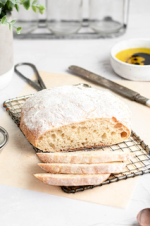
I found this recipe for Small Batch Ciabatta and I thought I'd share it here. I haven't tried this yet so I will report back once I make a loaf. This only uses ONE CUP of flour so should be great for one or two people. (For complete illustrated instructions, this is the link.)

1770396783085.png

Small Batch Mini Ciabatta (Made with 1 CUP of Flour)​


The dough can be cut in half for long sandwich loaves or in quarters to make dinner rolls or soft slider buns!

Ingredients (Recipe author recommends weighing ingredients so weights are shown)​

  • 1 cup (120 grams) all purpose flour (plus more for dusting)
  • 1/2 teaspoon (3 grams) salt
  • 1 teaspoon (3 grams) instant yeast
  • 1/2 cup (105 grams) warm water (90°F)
  • 1 1/4 teaspoon (5 grams) extra virgin olive oil

Instructions​

  • In a medium bowl, whisk together flour, salt, and instant yeast. Make a well in the middle of the bowl; pour the warm water and olive oil into it.
  • Mix with a dough whisk until the dough comes together in a messy ball in the bowl. Scrape down the sides of the bowl, make sure there's no sneaky lumps of flour hiding inside. Cover the bowl and let the dough rest for 20 minutes.
  • First set of folds: Use a damp hand to gently grab the top edge of the dough, stretching it away from you, then down over the center of the dough. Then rotate the bowl a quarter turn and repeat, grabbing the new top edge, stretching it away from you, then folding it down over the center. Repeat two more times for a total of four folds. On the last fold, flip the dough over and do a gentle slap and fold in the bowl by scooping the dough up in one hand, "slapping" the side closest to you it down in the bowl and folding the dough over itself and away from you as you slide your hand out from under it. Rotate the dough or the bowl a quarter turn between each set of folds, so you're always sliding your hand under the tucked under edge of dough facing away from you. Cover the bowl and let the dough rest for 20 minutes.

    If the dough is wet it won't stick to the side of the bowl and you will have a less dramatic "slap"; that's okay. What really matters is that repeated folding motion.
  • Second set of folds: Use a damp hand to repeat the 4 stretch-and-folds followed by 4-5 slap and folds in the bowl. Cover the bowl and let the dough rest for 20 minutes.
  • Third set of folds: Perform one final set of stretch-and-folds and slap-and-folds in the bowl. Do your best to get all edges tucked underneath with nice smooth surface tension on top of the dough. The dough should feel much more bubbly and airy at this stage and won't stretch as far as it did on the earlier sets of folds. Cover the bowl and let the dough rest at room temperature for 30 minutes.

    The dough will spread out and rise slightly in the bowl during this final rest, but may not double in size.
  • Preheat the oven (or toaster oven) to 450°F while the dough rests.
  • Dust the top of the dough in the bowl with flour, then gently tip it out of the bowl and on to a well-floured clean countertop so that the un-floured side is now facing up. Be patient and gentle with the dough so it doesn't deflate.
  • Dust the sticky top side of the dough lightly with flour. If you're cutting it into smaller rolls, do so now using a sharp bench scraper in clean up and down movements. Cover with a clean dish towel and let the dough rest for about 5-30 minutes. If you need to let it keep resting for another 5-10 minutes while the oven gets to temp that's okay — just cover it with a clean dish towel so it doesn't dry out. It's better to get it in the oven at the right temperature than to rush it!
  • Line a sheet pan with parchment paper. Dust any excess flour off the top of the dough, then slide a bench scraper under the ciabatta loaf in one quick movement. Lift and gently flip it over onto the sheet pan so the underside is now facing up. For a less floury ciabatta, gently dust any excess flour off the top. If you don't have a bench scraper, use your hands to flip it.
  • Bake for 20-22 minutes until puffed up and browned on top. If you want to be precise, you're looking for an internal temperature of at least 190F. For a softer ciabatta, bake for 18 minutes. Ciabatta will seem very hard and crusty when it first comes out of the oven, but will soften as it cools. Let cool before slicing!
 
Last edited:
Years ago my local Safeway used to sell unsliced loaves of bread made in their bakery...then it went away. I loved it for cutting thick slices for French Toast. When I got my Breville convection oven, I stated baking again and have made loaf bread and brioche for the sole purpose of being able to make thick slices for French Toast. Brioche is a great bread for making French Toast.
 
A while back, @Hedi Mitchell mentioned using a King Arthur Flour kit for making foccacia. I saw the mixes for sale in Kroger and bought a couple; today I decided to try one out. It was very easy to make, basically adding olive oil and hot water; everything else is included in the kit.

It turned out really good, and I baked it in my Breville countertop oven. Crunchy outside and soft inside; I think it will make great sandwich bread. If interested, you might find the kit in your local grocery store, or buy directly from King Arthur website... https://shop.kingarthurbaking.com/items/crisp-airy-focaccia-mix-kit

Thanks for the recommendation, Hedi!!
 
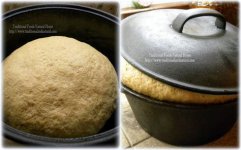
Anyone ever make sourdough cast iron Dutch oven bread, Basque Sheepherders way?

I searched for a video to share about it, but after several disappointing videos where yeast was used, I gave up. Traditional Basque Sheepherders bread always used sourdough. Reason being, the altitude where they grazed their sheep required a strong sourdough to raise the cast iron lid when rising. If the lid didn't raise, then the bread was a failure. A good sourdough starter was one of ten necessary things all Basque Sheepherders had.

In the past, I have made it in campfire coals, but mostly in a wood cookstove oven. After leaving the mountains, I lost my sourdough starter and haven't tried making Basque style Sheepherders bread, since. Using yeast just doesn't seem right to me and the failure to rise with power, loses the connection to a time where living was hard but rewarding for those that stayed the course.

I wish I had my old cast iron Dutch oven (it was made in the late 1880s), my old wood cookstove, and a 100 year old Basque sourdough starter. I would be making bread this morning. Nothing like fresh baked Basque Sourdough bread with local made butter applied in a liberal fashion.

OIP-3470255047.jpg
 
Last edited:
Anyone ever make sourdough cast iron Dutch oven bread, Basque Sheepherders way?

I searched for a video to share about it, but after several disappointing videos where yeast was used, I gave up. Traditional Basque Sheepherders bread always used sourdough. Reason being, the altitude where they grazed their sheep required a strong sourdough to raise the cast iron lid when rising. If the lid didn't raise, then the bread was a failure. A good sourdough starter was one of ten necessary things all Basque Sheepherders had.

In the past, I have made it in campfire coals, but mostly in a wood cookstove oven. After leaving the mountains, I lost my sourdough starter and haven't tried making Basque style Sheepherders bread, since. Using yeast just doesn't seem right to me and the failure to rise with power, loses the connection to a time where living was hard but rewarding for those that stayed the course.

I wish I had my old cast iron Dutch oven (it was made in the late 1880s), my old wood cookstove, and a 100 year old Basque sourdough starter. I would be making bread this morning. Nothing like fresh baked Basque Sourdough bread with local made butter applied in a liberal fashion.

View attachment 1013

Faye, sourdough is one thing I've never tried to make. I guess I should give it a go but it always sounds so complicated with starter and whatnot. You know you can get a Lodge cast iron dutch oven for a reasonable price, or probably find one at a thrift store. If you decide to make the bread, post all the steps because I'd love to hear about it.
 
Faye, sourdough is one thing I've never tried to make. I guess I should give it a go but it always sounds so complicated with starter and whatnot. You know you can get a Lodge cast iron dutch oven for a reasonable price, or probably find one at a thrift store. If you decide to make the bread, post all the steps because I'd love to hear about it.
If I could get my hands on a Basque sourdough starter, I might suffer temporary insanity and try making Sheepherders bread again. Back in the day, I ground my own grain and it was a real trick using Triticale. There are several recipes for using yeast to make cast iron oven bread, but I don't think it would be any different than just making a loaf. Coating the insides of the cast iron oven with lard, might be what adds to the flavor besides the sourdough.

Another thing is that the foreign made cast iron doesn't work like the old USA made ones. The USA is smoother and once seasoned didn't require much lard to coat it. There is flavor in those old coatings.

There is debate where the dough should be all hand worked or if using a machine makes any difference. I advocate for hand kneading. I found that feeling the dough, tells you when it is ready. It will take a few flat ugly loaves before you get it all pretty. Even the ugly ones taste good.

I am searching for a traditional recipe.
 
Last edited:
Back
Top